Sunday, 10 February 2013

Gold in Galilee


We spent last night in a lovely monastery on a high hill in Nazareth. As I lay in my bed falling asleep, I was very aware that Jesus, Mary and Joseph had laid down in their beds and slept very near to were I was.

The Wedding at Cana

Our first stop this morning was at the village of Cana, which is not far from Nazareth. In fact, when Nathanel says “nothing good can come out of Nazareth,” I can better picture a little small town rivalry going on.
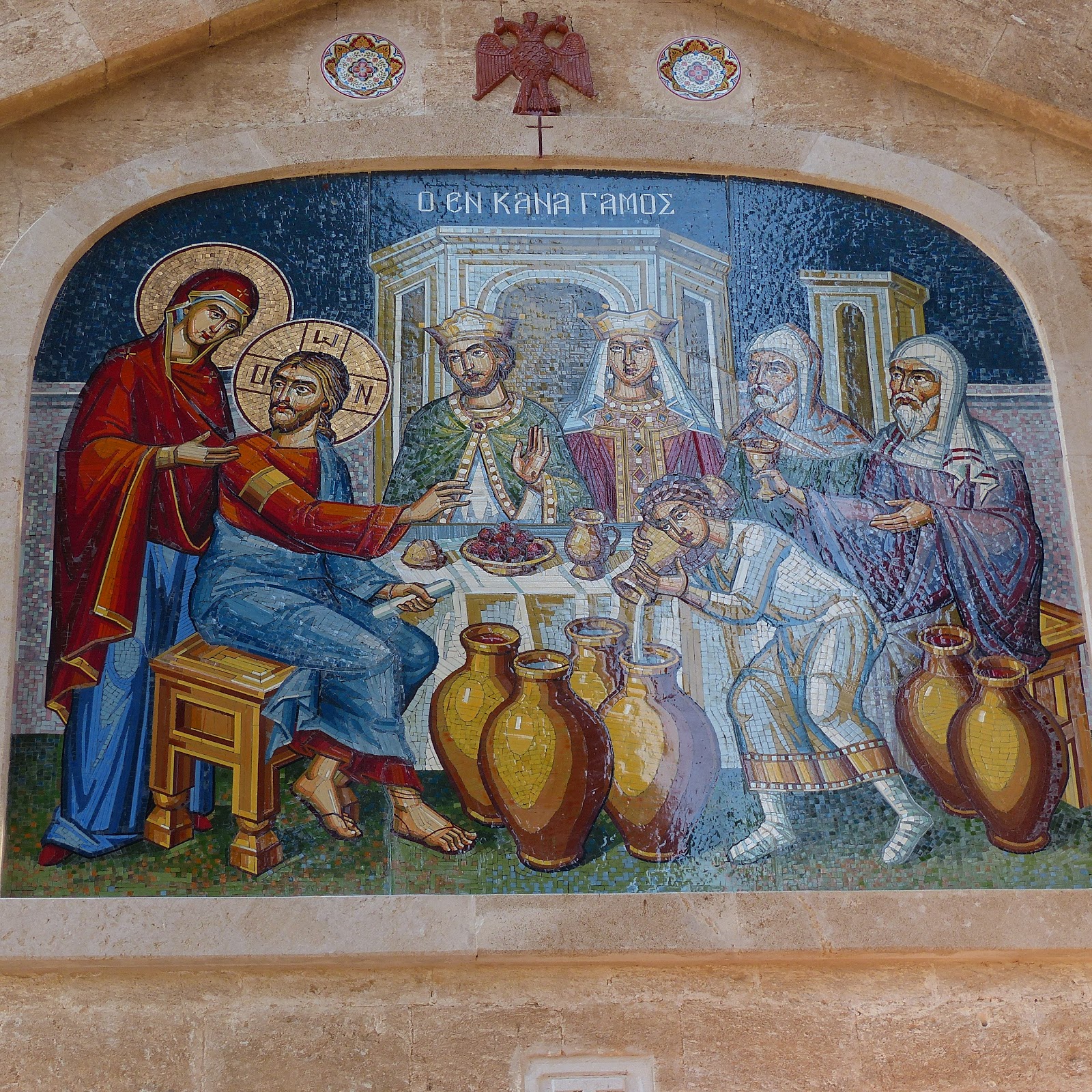
The Wedding at Cana
Cana was where Jesus performed his first miracle in turning the water in to wine at the wedding feast.        


An Ancient Cana Water Jug


This picture is of an ancient water jug found in archeological dig in Cana.

Cana Water Jug, water to wine


Mount of Beatitudes
Following in the steps of Jesus, our next stop was at the Mount of the Beatitudes. From the church built on this hillside, you can see the beautiful Sea of Galilee.


Mount of Beatitudes looking over the Sea of Galilee


We walked from the top of the hill down through a field, just as Jesus did, in this very place. Wow!
He would have picked a grain of wheat from the field, and told a Life story using it. He would have picked up a mustard seed flower, and told another story about the Kingdom of God with it.


Picking wheat from the field on the way to the sea of Galilee


When we reached the bottom of the hill, we saw a cave that would have been “the quiet place” that Jesus would retreat to pray. And then to emerge to talk about the Beatitudes that the people gathered below to hear.


What an amazing experience to trace Jesus’ steps in this way.


Capernaum

Capernaum is not that far from the Mount of the Beatitudes, and it is the town Peter is from. Jesus would have spent a good amount of time in this small fishing village, teaching in the synagogue, healing those who came to him, and staying in Peter’s house.

The foundation of St.Peter's house, and what was later a church


Peter’s house, after the Resurrection of Jesus, would become a place where Christians would gather for celebrating the Lord’s Supper.


As we go through all of these sacred sites, it is also interesting to note that there are other pilgrims from all over the world, of every colour and language and ethnic back ground - all seeking to follow in the steps of their Lord.


I am so thankful for the archeological witness to the life of Jesus and the early church. I am  more thankful for the Living Faith imparted to us by our Living Lord.


Saturday, 9 February 2013

The Wonder and Beauty of Nazareth


Caesarea Maritima

Caesarea Martima
Our first stop today was at the ancient coastal city of Caesarea Maritima. It was a city that Herod the Great had built to increase his coastal defenses and commerce with the rest of the Mediterranean. It is the place where Pontus Pilate had his home and headquarters (he only went to Jerusalem 3 times a year for festival gatherings and crowd control). More importantly it was the place of the first gentile Christian baptism; where Peter had the vision that all food is clean and that the Christian Way is also for the Gentiles; and one of the places where Paul was imprisoned. It is also interesting to note that Saints Jerome, Eusibius, and Origin all lived at some point at Caesarea Maritima because of its learning culture. 

Some of the Ancient ruins at Caesarea Maritima


Caesarea Maritima is has a beautiful beach on the Mediterranean Sea.


Mount Carmel

Our next stop was at the top of Mount Carmel to the Carmelite Monastery. Mount Carmel is the place where the prophet Elijah slaughtered 400 of the prophets of Baal, and challenged the Israelites to return to their faith in Yahweh.

Elijah


The view of the valley from on top of this mountain is breathtaking, looking down unto the valley and the river.

The view from on top of Mount Carmel


Nazareth

Nazareth. Mary and Joseph’s home. The place where Mary conceived of the Holy Spirit. The place where Jesus grew up. In ancient times, Nazareth was not a good place to come from because it was so small and of no account. Only a couple of hundred people lived there at the time of Jesus. 

The experts seem to have little doubt that the cave under the Church of the Annunciation was the place of the home of the Holy Family.

The cave that was the home of the Holy Family in Nazareth


I sat and prayed in this spot for some time. Mary conceived of the Holy Spirit very near to this sacred place. After the birth in Bethlehem, they returned to raise Jesus in this very place (except for their journey into Egypt to protect Jesus’ life from Herod). Nazareth was their home. 


Not far from here is the ancient well for the town of Nazareth. Mary would have lived much of her life going back and forth from her home to this well in the morning and afternoons. It is wonderful to imagine the Holy Family in the small town of Nazareth living a daily ordinary life in what was a very small town. 

Mary's Well in Nazareth


As I sat before the Holy Shrine of the Annunciation, I was remembering Mary’s total vulnerability and openness to God’s Divine Life. She models for the spiritual path to Incarnation - to becoming aware of God’s Spirit, God’s very Life, within us. God with us. With every human being. Everywhere.


Church and Shrine of the Annunciation

Friday, 8 February 2013

North of Jerusalem


North of Jerusalem: Shechem (Nablus);  and then Bethany

This morning we headed an hour north to the town of Nablus. Nablus is significant to the pilgrim for a number of reasons. It is the place where Jacob re-established one of Abraham’s wells, and the well is there to this day and has always been known as “Jacob’s Well.” It is in what was the ancient town of Shechem. After the kingdom of Israel divided into the north and south, a temple was established at Shechem by the Samaritans - an offshoot of Judaism. It was also at this Jacob’s Well that Jesus met the Samaritan woman.

It was at this Jacob’s Well where I found myself today!! To be at the very place where Jesus ministered to the Samaritan woman. To drink the water out of the well that Jesus would have had water out of. To say it was an amazing experience is an understatement. 

Jacob's Well

Drinking water from the well that Jesus would have drank from


As amazing as it was to be in such a holy place, and to drink water out of a well that Jesus would have had water, when I was up in the Greek Orthodox Church above the well reflecting on the experience, I did remember what Jesus said to the Samaritan woman: 


“Everyone who drinks this water will be thirsty again; but whoever drinks the water I shall give will never thirst; the water I shall give will become in him a spring of water welling up to eternal life.” It is an amazing experience for the pilgrim to drink water from this holy place, but the real water of eternal life is to be found within us wherever we are. Even in Conception Bay North!!


A Samaritan Priest


We then had the privilege of meeting the Samaritan Priest in the Samaritan synagogue on Mount Gerizem. There are only 750 Samaritans left in the world. The location of the ruins of the ancient temple on Mount Gerizem is now occupied by the Israeli army.


The beautiful country in the West Bank, Palestine


As our excursions have brought us deeper into the Palestinian West Bank, it is easy to understand the frustration of the Palestinian people as more and more Israeli settlements are being put into place on Palestinian land, and the Palestinian people are helpless to stop the Israeli’s from expanding into their land.


Lazarus' Tomb
After a beautiful lunch in the Palestinian City of Nablus (with a population of 250,000 people), we made our way back to south side of Jerusalem to the town of Bethany. Lazarus, Mary and Martha had a home in Bethany where Jesus would stay. Bethany is also the place where Jesus, four days after Lazarus had died, called him to life out of the tomb. I had the opportunity today to stand near that holy place.


Outside of the tomb. Maybe near to where Jesus was standing when he called Lazarus out.
I am really feeling like I am walking in Jesus’ footsteps. This pilgrimage is turning out to be much more than I had hoped it would be.


Tomorrow we head north to Galilee, and will spend four days following Jesus’ ministry around the sea of Galilee. 

Thursday, 7 February 2013

Bethlehem and the Birth of Jesus


The Birth of Jesus, Bethlehem

What an amazing day. The College leaders called it “Mothers Day” for us because it was about Mary and Elizabeth and the birth of Jesus and John.

So we started today making our way to Bethlehem. But our first stop was to the place of the Visitation, a town called in Hebrew Ein Kerem. “During those days Mary set out and traveled to the hill country in haste to a town of Judah “(Luke 1:39). After Mary had conceived of the Son of Man in her womb, she set out to see Elizabeth in the hill country.

The hill country of Judea 


This picture is taken from the well that Elizabeth would have used when Mary had visited her. The Judaean hill country. And it is very beautiful. The Church of the Visitation, on top of the mountain looking down upon the this lush valley, is built on the location where Zachariah and Elizabeth would have been living when Mary visited.


It was a beautiful feeling to be walking in the place where Mary, the Mother of God, would have walked while she was pregnant with Jesus.


Church of the Visitation


Our next stop was to a shepherd’s field near Bethlehem, a place not unlike the field that the shepherd’s from the Biblical story would have received the revelation from the Angels that the Saviour of the World has been born in a manger.

The Shepherd's Field 

A typical cave like the one Jesus would have been born in


We also got to see a cave that was not unlike the cave and manger that Jesus would have been born in.


After getting a feel for what a cave and residence of that time would have looked like (without the shrine effect that has been built over the actual site at the Church of the Nativity), we made our way to Jesus’ birth place. 


In the picture below is the entrance, under the altar in the church, to the cave and manger that Jesus was born in.


The entrance to the shine of the birth place of Jesus


Below is the actual location in the upper part of the cave that Mary would have given birth to Jesus. What a powerful spiritual feeling being in such a holy place.


The shrine at the actual place of Jesus' birth, according to tradition


I am so thankful for this opportunity to trace through the biblical story and walk in the places where the great figures of our faith have walked, and to follow our Lord’s steps in this Holy Land. 


The exit to the shrine of the birth, which is right under the altar

Outside of the Church of the Nativity


Wednesday, 6 February 2013

Hebron and the West Bank of Jerusalem


Hebron and the West Bank

Although I am in the Middle East, it is cold! We needed fleeces and jackets on today. With the rain, there was even a brief period of hail stones!!

We began the day by going to Hebron, with the traffic, it is about an hour south of Jerusalem. Hebron is the burial place of Abraham, the Patriarch of the world’s three monotheistic religions: Judaism, Christianity, and Islam. During the New Testament times, Herod the Great built a monument over the tombs of the Hebrew Patriarchs.

Monument building over Abraham's Tomb


This building is called the “Makhepelah,” the Tomb of the Patriarchs. And with Abraham, Sarah’s, Jacob’s and Rebecca’s tombs are also contained within.

Jacob's and Rebecca's Tombs


Not getting into the history of the monument, it is divided into two sections. These pictures are from the Islamic section, and within their mosque. The other section of the building is the Jewish section, and it also has access to the tomb of Abraham and Sarah. 


Abraham's Tomb


We also stopped at the site of the “Oakes of Mamre,” the place where Abraham exercised hospitality to the three divine visitors, and where God promised Sarah that she would have a child in her old age. 

The Palestine Refugee who spoke to us

Our walk through the refugee camp

In 1995 the refugees were allowed to build up


A street within the refugee camp in the West Bank


The highlight for me today was two other visits: one to a synagogue and a talk with an orthodox Jew living in the occupied West Bank; 


and the other to a Palestinian living in one of the refugee camps. We got to hear their own stories of how they understand  the eviction of the Palestinians in 1948, the Israel state, and how they see the future.  Of course these issue's and their history are complicated, and have no easy solution. Lets pray that with time, and educating the upcoming youth with a desire for peace and toleration, that the future will have hope.


Tomorrow we go to Bethlehem.


Tuesday, 5 February 2013

Jerusalem from the Mountain


Mountain Views of the Old City of Jerusalem, Tuesday, Feb 5

Today’s objective, with the help of a lecture this morning on the history of Jerusalem, was to get an overview and a “mountain” view of the Holy City.

The first stop we made was above the Kidron valley, to the right of the Mount of Olives, looking down unto the Temple Mount.

Dome of the Rock


What stands out most as one looks down upon the Temple Mount is the golden Dome of the Rock. At the Dome of the Rock, Abraham, father of Jews, Christians and Arabs, made his great act of submission in his willingness not to sacrifice his son.


Also to be seen just beyond the Temple Mount is the Dome of Church of the Resurrection, which is built above the tomb that Jesus was buried in and rose from.


Dome of the Church of the Resurrection


Between where we were standing and the Temple Mount, was the Kidron valley, which, after Jesus' entry into Jerusalem on Palm Sunday, he would have to walk through on his way to Gethsemene on the Mount of Olives, where he prayed before being arrested. 

Kidron Valley


Gethsemene on the Mount of Olives


Our next stop was the other side of the mountain on which Jerusalem is built, and it looked out into the Judean Desert. This is the place that David would have fled from Absolom; it is where Jesus prayed and fasted for 40 days and 40 nights.

Judean Desert


In the process of getting an overview of the Holy City today, this was the vantage point that  I appreciated the most. And especially with Lent so near. This is the place that Jesus retreated to after being baptized by John in the River Jordan. 

The other thing that stood out for me today was the wall that separates Israel from Palestine. I’ve seen it enough times on the TV. But it different seeing it for yourself. It is a sad symbol of two culture's unwilling to reconcile with one another.

The wall dividing Palestine and Israel

Yet Jesus, at a deeper level, has revealed to all people, that there is nothing that can separate us from one another or from God. There is a Divine Love within us that unites us and makes us one - no wall can stop that!

Arriving in Jerusalem


Arriving in Jerusalem, Monday, February 4

Gwen and I left her house 3:30 this morning to make our way to Heathrow airport. Needless to say that I didn’t sleep much. It was strange and pleasant to experience the streets of London empty and quiet.

From airport terminal 1, I left at 6:20am on a German carrier to Frankfurt, Germany; and then on the same carrier to Tel Aviv, Israel.

It was a wonderful feeling to be flying over the Mediterranean and to see the shores of Israel appear. Israel. I am in Israel. Wow. Israel: he who struggles with God. Israel: the land that our Lord Jesus walked upon.

Of course God is not in a single geographical place. God’s creative hand is in all of creation throughout the whole of the universe. And God is in every single human being - that is what Christians celebrate in the Incarnation at Christmas. 

In fact, as a favorite author of mine likes to quote, God comes to us disguised as ourselves. 

Or another favorite quote: my deepest me is God.


What makes this holy land more special is because the historical Jesus walked upon its shores, its roads, its towns. 


The view from my room at night

 St.George’s College, which is where I am staying and from where the course is being taught, is in the old city of Jerusalem. The streets are busy and congested. And it is easy to see the new developments in Jerusalem, and that which is part of the old city.

Entrance to the college

I arrived just in time this evening for the opening Eucharist for the course in the Cathedral. The realization occurred to me while we were celebrating the Holy Communion is that I have now shared in the Lord’s Supper in the very city that He took bread and wine and said “this is my body, this is my blood.” Wow.


St.George's Cathedral
This is going to be a wonderfully Spirit filled pilgrimage to this Holy Land of our Lord.